
Navigating Accreditation for Infusion Services
By Gita Hosseini, RPh, BCSCP & Caroline Girardeau, PharmD, MBA, PMP, BCPS
Gita Hosseini has served as a leader for specialty pharmacies, home infusion providers, and ambulatory infusion centers. As an ACHC Pharmacy Surveyor, Gita uses her years of frontline expertise to help healthcare organizations achieve the highest standards of compliance and patient safety.
Caroline Girardeau brings more than 30 years of pharmacy experience to her position as Program Director for ACHC Pharmacy and PCAB (Compounding Pharmacy) Accreditation. She combines clinical expertise with a passion for education to help pharmacies strengthen their practices.
Posted: September 18, 2026
When organizations begin preparing for accreditation, one of the first challenges is determining which ACHC Accreditation options apply to their operations.
For pharmacies that offer infusion services, terms like AIC, AIS, IRX, IRN, and HIT are often used interchangeably, but each represents a distinct accreditation pathway with different oversight requirements, staffing models, and care environments. Differences include the medications to be infused, provider types, where medications will be infused, and how administration services will be billed.
A clear understanding of these distinctions helps ensure accurate scoping and an accreditation process tailored to your needs.
The table below provides essential details for infusion services accredited by ACHC. (Medicare Part D references are limited. Medicare Part D generally applies to drug cost for self-administered medications and not the cost of administering a drug by someone other than the patient.)
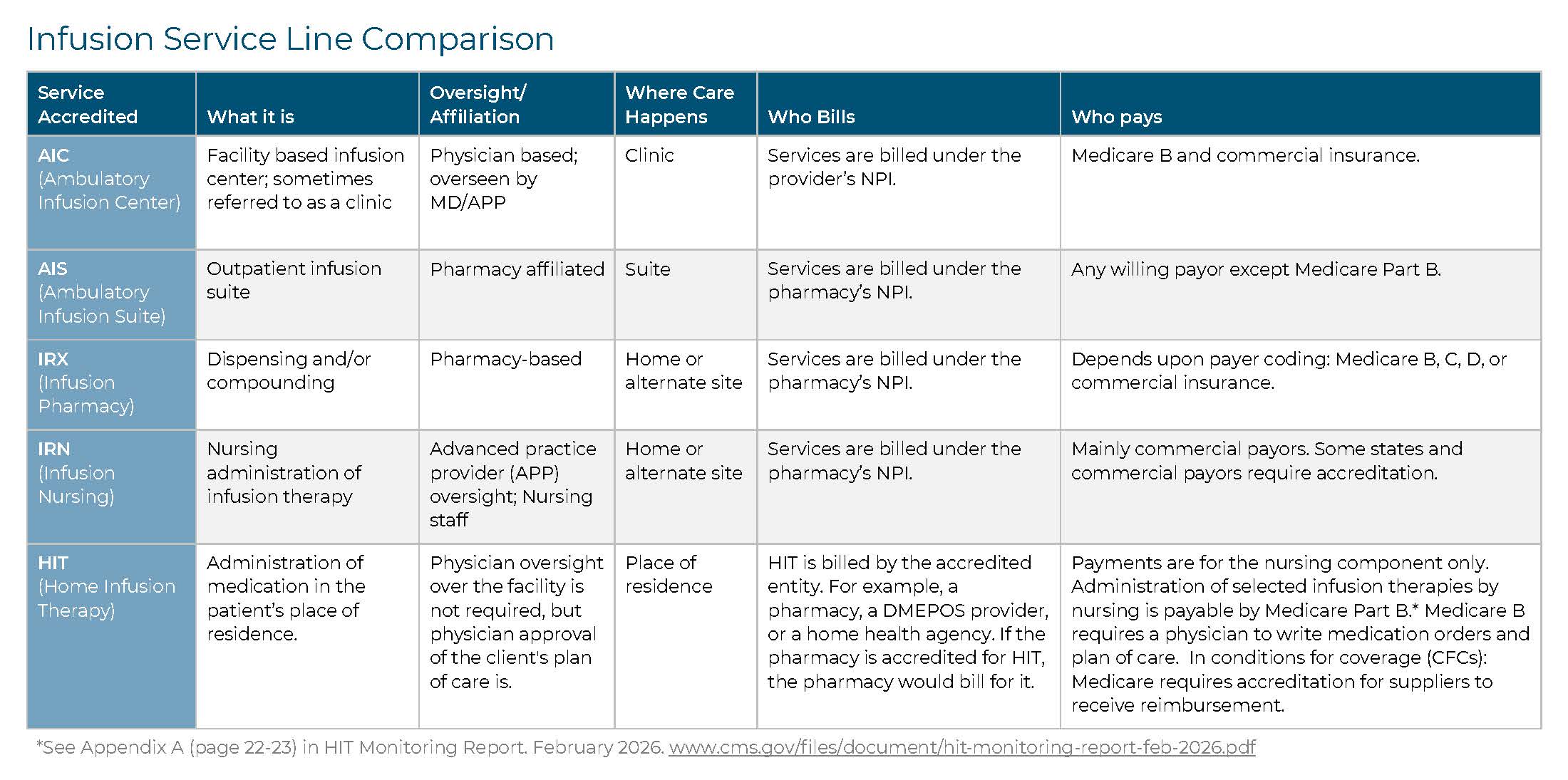
Key distinctions
AIC vs. AIS: Provider-Based vs. Pharmacy-Based Practices
Ambulatory infusion center or suite? ACHC AIC Accreditation covers both AIC and AIS services, giving you a one-stop shop for pharmacy-connected infusion suites and outpatient centers.
The governance model and clinical leadership differ for each service—which matters for ACHC Accreditation. Achieving accreditation helps secure reimbursement for both services.
- An AIC is commonly provider‑based, with oversight from an MD or an advanced-practice provider, such as an APRN or PA.
- An AIS is typically pharmacy‑affiliated, operating as outpatient infusion suites with a different staffing and oversight structure.
- As of September 2026, the AIC and AIS standards are the same. AIS and AIC standards will be separated in 2027. AIC standards are currently available on Customer Central.
IRX vs. IRN: Pharmacy vs. Nursing Responsibilities
These are separate service lines with separate ACHC Accreditation Standards.
- IRX covers the pharmacy side of infusion therapy: compounding, dispensing, patient education, and clinical monitoring.
- IRN covers the nursing side: assessment, administration, monitoring, and patient support during infusion.
HIT vs. IRN: Who is prescribing? How are you planning to get paid by Medicare or commercial insurers?
Home Infusion Therapy Accreditation is separate from ACHC Pharmacy Accreditation. It is applicable only to Medicare reimbursement for infusion services provided in the patient’s place of residence.
CFR 486.520(a) states: “All patients must be under the care of an applicable provider.” This CMS regulation does not specify who may or may not write patient or medication orders. However, CFR 486.520(c) states: “The plan of care for each patient must be periodically reviewed by the physician.” The HIT benefit reimburses for infusion of a limited number of medication HCPCS codes, per the HIT Monitoring Report February 2026.
Additional information:
- If you bill Medicare C for HIT services, depending on the rules for the Medicare C plans, bundled S codes (nursing, medication, and equipment) can be used for reimbursement.
- If you bill Medicare B, you have to be an accredited HIT supplier. HIT requires very specific documentation (Medicare forms). Bundled S codes are typically used to bill commercial insurers.
- In addition to CMS regulations, state legislation pertaining to home-based infusion administration may vary. For example, home health licensure is not required in all states. Additionally, some states allow only a physician to write medication orders if home-based infusion administration is provided by a nursing agency.
- Overall, IRN documentation is much simpler than HIT documentation. IRN accreditation applies to the administration of all medications. For this reason, facilities often elect to get accredited for both IRN and HIT services. Advanced practice providers (APP) may prescribe under IRN. With accreditation for IRN, you can also bill all commercial payors. In some states, private duty nursing may be eligible for Medicaid billing with IRN accreditation.
Accreditation needs
Many organizations need to be accredited for more than one service. Accreditation standards are service‑line specific, so accurate scoping is essential. For example:
- A pharmacy that compounds medications and provides home infusion nursing needs IRX and IRN accreditation.
- A physician-owned facility/clinic that compounds medications, operates an infusion center, and bills under the provider’s NPI needs IRX and AIC accreditation.
- A pharmacy-owned facility that compounds medications, operates an infusion suite, and provides nursing services to administer medications in the home—and bills under the pharmacy’s NPI—needs IRX, AIS, and IRN accreditation.
Top takeaways
Understanding the differences between AIC, AIS, IRX, IRN, and HIT services helps organizations align the services they provide with the correct ACHC Accreditation. Clear definitions of what you provide, who oversees it, where care occurs, and your billing practices are the foundation for a successful accreditation process.
--
Discover more articles about ACHC Pharmacy Accreditation and PCAB (Compounding Pharmacy) Accreditation.