
Documentation Drives Histopathology Quality Control
By Tommie L. Hawkins, BS, HT (ASCP), Laboratory Specialist
Tommie Hawkins’ experience in laboratory medicine includes a strong background in both histology and laboratory operations. Tommie served 23 years in the U.S. Air Force, where he managed an anatomic pathology department. Prior to joining ACHC, he managed a dermatology laboratory and worked as a hospital histology technician. He is a past board member of the Nebraska Histology Society.
Posted: November 10, 2026
Your histopathology laboratory has established procedures. Your team understands the importance of quality control. And every day, careful attention goes into preparing tissue specimens and slides for diagnostic review.
But here's a question worth asking: If someone needed to verify that your quality control procedures were performed correctly, could your documentation tell the full story?
In histopathology, documentation does more than demonstrate compliance with accreditation requirements. It helps establish that the processes supporting accurate diagnostic interpretation are consistent, reliable, and appropriately monitored.
Quality starts long before diagnosis
Consider everything that happens before a pathologist examines a tissue slide.
Tissue must be properly fixed and processed. Sections need to be the appropriate thickness. Stains must perform as expected, and cover slipping must protect the slide without interfering with interpretation.
Even something as simple as a fold, tear, or cracked slide can affect its diagnostic usefulness.
These steps may be routine for experienced histology professionals, but routine doesn't mean they should go undocumented.
Quality control records provide evidence that necessary checks were performed and that slides met acceptable standards for diagnostic review.
When slides travel between labs
Not every histopathology laboratory handles both slide preparation and diagnostic interpretation.
In some cases, one facility performs the technical work, including tissue processing and staining, while another provides the professional interpretation.
When responsibilities are divided, documentation becomes especially important.
Both laboratories should maintain records demonstrating acceptable slide preparation and stain quality control.
The receiving laboratory should also assess and document slide condition. Are the slides readable? Are any cracked, damaged, or stuck together with mounting medium?
These records help maintain consistent quality expectations, even when different facilities contribute to the diagnostic process.
Are you capturing the right details?
A quality control log should tell more than whether a stain passed or failed.
For example, could someone reviewing your records identify which reagent lot was used? When materials were opened? Whether controls were tested when a new shipment arrived?
Effective histopathology documentation should include:
- Reagent and stain lot numbers.
- Dates materials were prepared or opened.
- Expiration dates.
- Actual measurements, reactions, and observations.
- Results of appropriate control testing and verification.
Staining procedures also have specific requirements.
Under 42 CFR § 493.1256(e)(3), fluorescent and immunohistochemical stains must be checked for positive and negative reactivity each time they are used. Results must be verified and documented as acceptable by a qualified pathologist or designee.
Other differential and special stains require controls with known reactivity and documented results. Certain validated polymer-based immunohistochemical detection systems may allow laboratories to omit negative reagent controls at the laboratory director's discretion.
Understanding these requirements helps histopathology laboratories establish consistent documentation practices and maintain confidence in their staining processes.
Quality doesn't stop at survey time
It's easy to think of documentation as something to review when an accreditation survey approaches. But its greatest value comes from making it part of everyday histopathology operations.
Consistent quality control records help demonstrate that procedures are followed, identify opportunities for improvement, and support reliable diagnostic services.
At ACHC, we understand the technical demands of histopathology and the importance of maintaining quality at every stage of specimen preparation and evaluation.
Daily slide review example
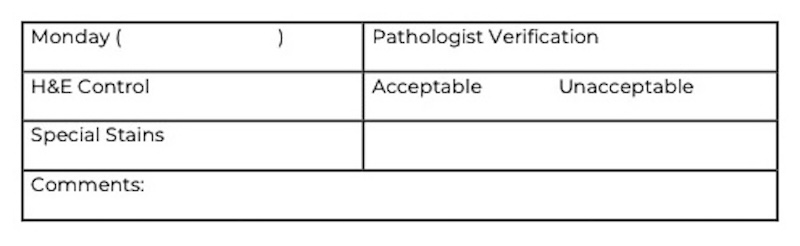
Daily quality control slide log example

--
Read more articles about Clinical Laboratory Accreditation here.