
Cleanroom Reality Check: Training vs. Competency
By Stephanie Xenakes, RPh, BBA, BCMTMS, ACHC Pharmacy Surveyor
Stephanie has more than 35 years of experience in hospital, retail, and infusion pharmacy practices. As an ACHC Pharmacy Surveyor, Stephanie helps healthcare organizations strengthen medication safety, quality improvement, and regulatory compliance across the continuum of care.
Posted: September 21, 2026
Across dozens of surveys, we find that compounding pharmacies seeking or renewing PCAB (Compounding Pharmacy) Accreditation often use the terms “training” and “competency” interchangeably. However, they represent fundamentally different requirements.
“Training” refers to education like didactic instruction, online modules, or video-based learning such as YouTube content. While some individuals may be able to replicate actions after viewing instructional material, others require hands-on demonstration followed by direct observation to confirm proficiency and ensure correct performance.
“Competency” refers to the observable ability to perform a specific task, including evaluation and confirmation of understanding. Both training and competency require written documentation to be compliant with PCAB (Compounding Pharmacy) Standards.
Frequently, during onsite reviews of compounding pharmacy personnel files, it is not the training program or module documentation that is found to be lacking but the competency assessments. These omissions are then cited as deficiencies. As the survey progresses to the observational part, it typically becomes clear why verification of competency is essential.
Why ‘first air’ matters
PCAB Standards TCRX3-B and TXCRX6-L address both policy and observational requirements for key sterile compounding competencies, including garbing, hand hygiene, environmental cleaning, and aseptic technique, with particular emphasis on the principle of “first air” in the cleanroom.
As illustrated below, deficiency findings are frequently identified in pharmacies where annual technician training modules have been documented but corresponding technician competency assessments are not performed.
This is especially evident in aseptic techniques, and blocked first air is a commonly observed deficiency.
In Photo A below, the technician’s hand and body positions are causing upstream airflow obstruction, directly blocking first air from reaching the critical compounding area. Photo B shows what is referred to as shadowing, where the technician has placed their hands and arms directly behind the syringe and vial hub—again, disrupting first air.
A further example is improper or inconsistent use of PPE during critical sterile compounding steps, as shown in Photo C). Here, a technician in an ISO classified area is using a powder hood to weigh an active pharmaceutical ingredient (API) in preparation for sterilization to make a Category 3 compounded sterile product (CSP). The technician should be wearing gloves.

PHOTO A
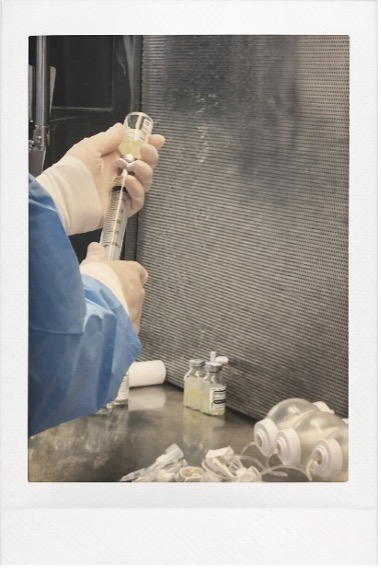
PHOTO B
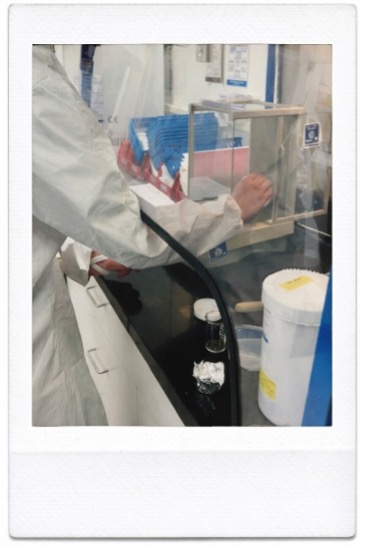
PHOTO C
Cleaning process
Another critical area requiring documented competency assessment is the cleaning process. Training materials may inadvertently introduce ambiguous terminology, such as “cleaning with an EPA-registered one-step disinfectant.” Without demonstrated competency validation, this language can be misinterpreted by personnel responsible for cleaning.
In addition, the term “one-step” can be misunderstood. This may lead to practices as seen in the example image, where a technician interpreted the instruction literally, combining cleaning agents into a self-created “one-step” solution consisting of CaviCide® and sterile isopropyl alcohol (IPA).
Because the pharmacist at this location had not directly participated in the cleaning process, and the cleaning log indicated that the technician was using both agents, the practice was not questioned.
What was intended was an EPA-registered and approved one-step cleaning and disinfecting agent. The technician’s competency was neither assessed nor validated.
While daily cleaning tasks may appear straightforward for competency assessment, weekly and monthly cleaning activities must also be validated. These tasks involve more comprehensive procedures and include additional surfaces, such as walls, ceilings, and other less frequently addressed areas.
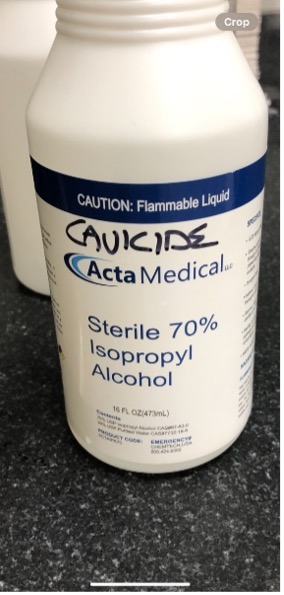
Image: "One-step" solution misinterpretation
Include definitions in training modules
Training modules must clearly define terms and expectations. For example, explain what constitutes a “wall” and that return vents must be included in monthly cleaning.
Without this level of specificity, critical areas may be overlooked, as illustrated in the example image. In this case, the compounding pharmacy’s return vents were located behind the primary engineering control (PEC). Cleaning personnel addressed only the visible wall surfaces above the returns and did not clean the vents. This oversight was later identified as the source of recurring colony forming unit (CFU) excursions.
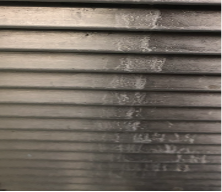
Image: Vents
Key takeaway
These examples underscore why documented competency assessments are critical to meeting PCAB (Compounding Pharmacy) Standards. Recognizing the need for competency validation, beyond simply completing training, is the first step toward achieving a highly compliant survey outcome.
--
Discover more articles about Pharmacy Accreditation and PCAB (Compounding Pharmacy) Accreditation.